Published 3/27/26
The Unholy City
Part II
VIII. No Exit
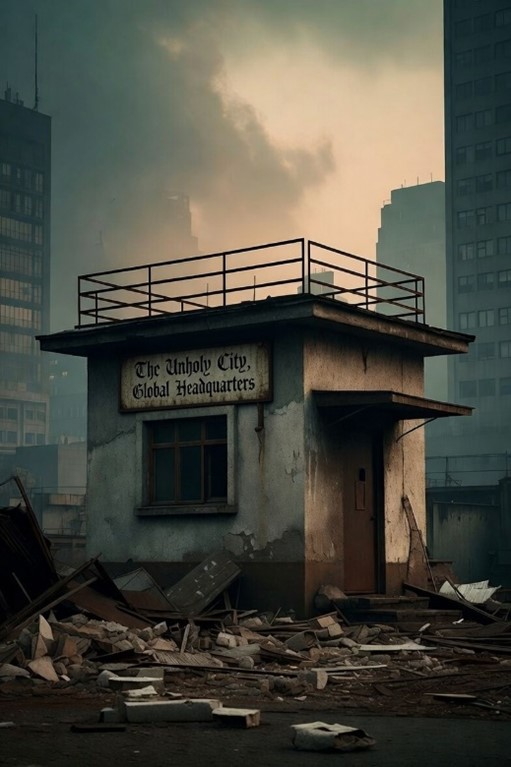
Let’s pause for a moment in front of the City’s Global Headquarters. Not very impressive, is it? That is because the City’s mechanism of authority is distributed, dispersed across a vast network of nodes, stretching across the planet. Any node can communicate with any other node. Each node can serve as the gateway to a subnetwork—a few private nodes or thousands or an entire nation’s network.
As a measure or index of the City’s growth, the increase of its infrastructural circulatory system, the Internet, serves to represent how the City’s authoritative and functional elements are conveyed to increasingly many people. What used to operate on a few servers and deliver a few megabytes of data per minute twenty-five years ago, now requires a huge server farm and delivers hundreds of terabytes over multiple broadband connections. It connects through the air, between continents via undersea cable, from satellites in space, and to each device in our homes. It travels wherever we go, on our smartphones.
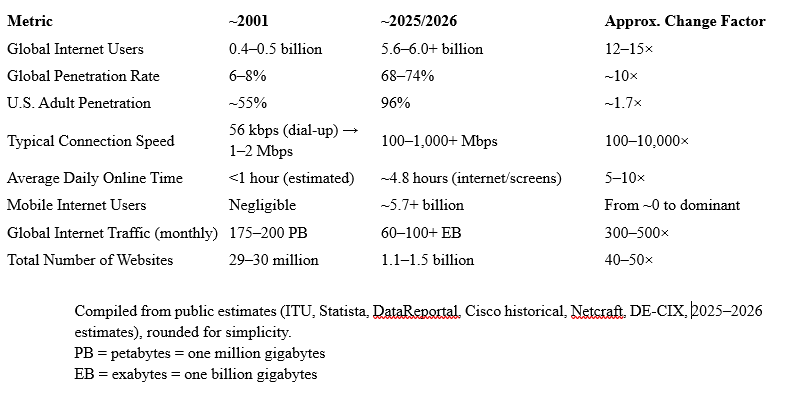
In 2001, the Internet had around 500 million users; today it is more than 5.5 billion users, an 11-fold increase. In 2001, 6-8% of the world was connected; today that is 73%. In 2001, it was dial-up, 56 kbps; today, there is fiber, 5G, and satellites, everywhere, generally 100 to 1,000+ Mbps. In 2001 there were about 30 million websites; today, there are over a billion. In 2001, there was about 197,000 terabytes of traffic per month; today, that figure is closer to 3,300,000 terabytes per day, a 300-fold increase. Most of the high-volume and high-speed infrastructure has been built or upgraded in the last 15 years, much of it far more recently.
In every way, the explosive growth of the Internet since 2001 is staggering. The wide acceptance of e-commerce transactions (around 2005) resulted in the movement of whole marketplaces onto the Internet. Entire commercial and industrial functions moved operations to the Internet. Global advertising expenditure grew from ~$7-8 billion (2001) to ~$710-777 billion (2025), a 100-fold increase. More comprehensive estimates place the global digital ad spend at more than $1T for 2026. Digital now accounts for ~75%+ of total global ad spend, up from < 5% in 2001.
The following chart illustrates the explosive growth in every metric:
Significant drivers of the growth of the Internet have been:
- the shift from traditional media (TV, print, radio) to digital (search, social, video, programmatic),
- the rise of mobile (smartphones post-2007) and platforms that serve them,
- the shift to online retail,
- the introduction of social media, and
- the shift of music and entertainment, around 2007, from physical media to streaming delivery.
Time in the form of attention from billions of people adds up to an economic force that has built the empire that has become the City. The typical usage of 4.8 hours per day adds up to about ten trillion hours of attention per year. The arithmetic is inexorable. The market value of all that attention is almost incalculable. Thus, many, many more marvels are coming as entrepreneurs compete to exploit the opportunity.
An immediate consequence of the growth described above, centered on the U.S. but ultimately exported to the whole world, is that American secular philosophy, consumer culture, and materialist values have been transmitted under the cover of services and entertainment to every nation on earth. It is baked into the product. Even with auto-translation to manage the language problem, English is still the dominant source of the semantic constructs. Thus, the introduction of the City into another culture results in another copy of the same City with a different skin. Given how quickly the worldwide expansion has occurred there has been no time to do otherwise, and now there is no need.
How will the City evolve to adapt to the needs of other cultures? At present it appears that superficial adaptation is all one can expect. As local, cultural content and interests are introduced into the system, they will be required to adapt to the structures and economics of the City, just as American culture, which was the first to be reshaped by these forces. All are compressed into the same shape by the views, clicks, and likes economy. The result is the slow (or perhaps quick) erosion of culture and traditions, the homogenization of humanity into a pan-cultural ethos. All content creators optimize for the same Algorithm, chase the same metrics, perform for the same engagement economy. This formula has resulted in the expansion we have already seen, and there is no reason to think that it will not continue and even accelerate.
The scale of the City’s empire makes it effectively sovereign. No government has yet been able to regulate it in a way that fundamentally alters its global scale or logic. Attempts to do so fail to constrain it, affecting only its local expression, usually very superficially. Besides, governments want it to grow. The City doesn’t discriminate; it serves all masters. Liberal democracies want it for surveillance against enemies and subversion. Authoritarian regimes want it for control. Corporations want it to increase their profits. Individuals want it for entrepreneurial ventures, to increase their connections, and serve their appetites. Criminals want it for the new and unprecedented opportunities it affords. Each, in using the resources of the City, also becomes its captive.
Much of the City’s strength lies in its invisibility. The global headquarters of the City are everywhere and nowhere. Most of the time, the City gets noticed hardly any more than the electricity service. Modern governance, commerce, education, and healthcare are now deeply dependent on its infrastructure. New commerce and its associated marketing are now almost exclusively confined to the City’s infrastructure. Human social interconnection is increasingly mediated by the City and its captive features.
The City has few rules. They are fluid, but it enforces them absolutely. Escape is impractical, and in some respects, impossible. Living off-grid is extremely difficult. Violating the rules risks de-platforming, de-banking, loss of payments, jobs, credit, health care, and “cancellation”. Even renting a place to live or traveling is at risk. Fringe views are generally not censored; the City simply stops serving them.
Vast beyond comprehension in its reach, its daily utilization, and its capacity, the City has lifted itself above nationality, law, culture, politics, languages, ethical considerations, morals, and religion. There is almost no part of life that has remained untouched. Even those parts of human experience and enjoyment that seem safe have been diminished by the theft of time and attention.
Ultimately, there is no escape from the intrusion of the City into life and the human community, anywhere within the City’s reach. The City’s intrusion means the introduction and establishment of not only its conveniences and enablements but its values, imperatives, and coercions.
The City’s “outside” is shrinking, as it engulfs new captive regions. Soon it will have no outside. Already, the sign is clearly visible: “No Exit”.
“Among my people are wicked men who lie in wait like men who snare birds and like those who set traps to catch men.”—Jeremiah 5:26 (NIV)
The Unholy City is licensed in its entirety under CC BY-NC-ND 4.0.
To view a copy of this license, visit
https://creativecommons.org/licenses/by-nc-nd/4.0/