Published 3/13/26
The Unholy City
Part II
II. The Illusion of Freedom
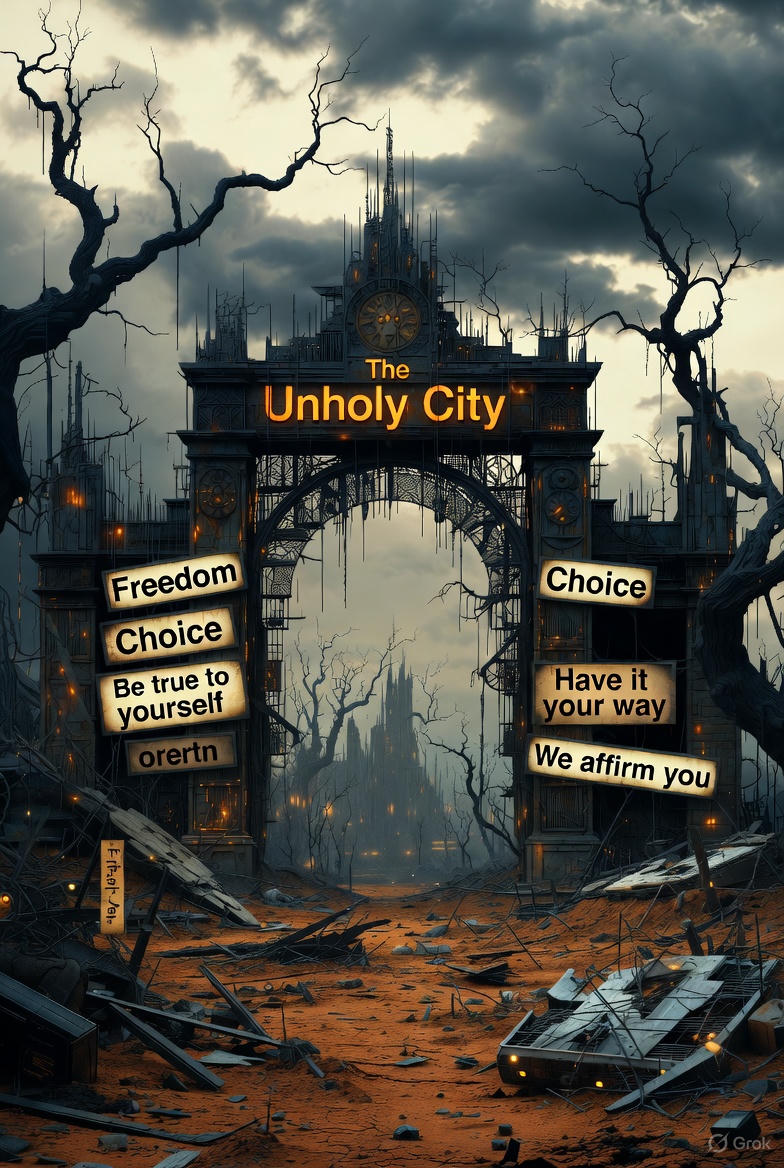
The gates of the City promise everything we thought we wanted. Is it all that we should want? There’s no way to know.
Throughout history, the great documents, the thoughts and testimonies of the great thinkers of western civilization, have had a regulating effect, recording, advising, restraining—feeding a measure of wisdom back into the community of thought and sometimes preventing the human family from repeating its worst experiences. That system has worked fairly well until recent times. Today, this loop is so vastly overloaded that constructive feedback is improbable. Information overload means that any truth is drowned in distraction, trivia, and misinformation; the signal-to-noise ratio has collapsed. Those who would inquire are buried in an avalanche of unbounded information with no wisdom and no way to acquire any. The potentially redirective voices of prophets and whistleblowers are hidden by volume. There is now no way for correctives to reach people, trapped as they are in ignorance and echo chambers. Social media has become, not a conversation, but thousands of individuals shouting at each other.
The City has created its own answer to that dilemma in the curated search.
Thus, the immediate benefit of the curated search, the personalized menu to the user, is very great. It is, in large part, the reason that the Internet has grown so enormously. We have more or less instant access to whatever we wish or wish to inquire into, whether it is products, entertainment, conveniences, medicine, social connections, and other technology—the sum of human knowledge and history at our fingertips. It makes no difference to the Algorithm what you are searching for. It applies a completely flat ontology, with no hierarchy of truth or value: conspiracy, science, faith, porn, and cat videos are equally “valid” results. Every political tribe, moral framework, and spiritual practice is available on demand, all contained within the same platforms, ranked by engagement, monetized equally. The Algorithm has no guiding telos beyond maximizing engagement.
The algorithmic curation done for us is very helpful, of course, screening out irrelevancies, off-topic links, and other unlikely alternatives, and placing those alternatives most likely to satisfy our inquiry at the top of the menu, saving time, puzzlement, trips to the library, and exasperation. We like it. In fact, we demand it. We voluntarily grant the City knowledge of many of the parameters of our lives so that we can have this.
So, what is the cost? We have already seen it. The City includes or promotes alternatives that advance certain causes that it favors: political, economic, commercial, social, religious, personal, professional, and so on. It doesn’t work all the time, but it doesn’t have to. Whether we accept or decline the option the City presents to us, our decision constitutes a data point, further refining our profile. And if, out of millions of presentations, an acceptable fraction is successful in swaying the choices of the users in the desired direction, it is enough. The City will try the others again another time. All the while, the users are being subtly shaped.
This seems like a modest cost, if any, and while we may be aware of it when the City presents us with a choice that is a little outside our accustomed envelope, we can just decline it and move on. What matters is the occasions when we are not aware. The systems architects learned from decades of advertising and behavioral psychology that subtle influence is highly effective, choices shaped by design rather than explicit persuasion, seen but not noticed—the ring of Pavlov’s bell.
That bell is constantly being rung. And we respond, because in our interactions with the City, our freedom is an illusion and our choices are unreal. When we use smart phones, tablets, or PCs, we are living under the tyranny of the City’s Algorithm, the process that analyzes your metrics and makes all the decisions. By it, the City satisfies the users’ desires and appetites, so far as it suits the City’s purposes, not for the users’ benefit but for the City’s growth in power and authority.
Although these false teachers promise such people freedom, they themselves are enslaved to immorality. For whatever a person succumbs to, to that he is enslaved.—2 Peter 2:19 (NET)
The Unholy City is licensed in its entirety under CC BY-NC-ND 4.0.
To view a copy of this license, visit
https://creativecommons.org/licenses/by-nc-nd/4.0/