Published 3/11/26
The Unholy City
Part II
I. A Matter of Choice
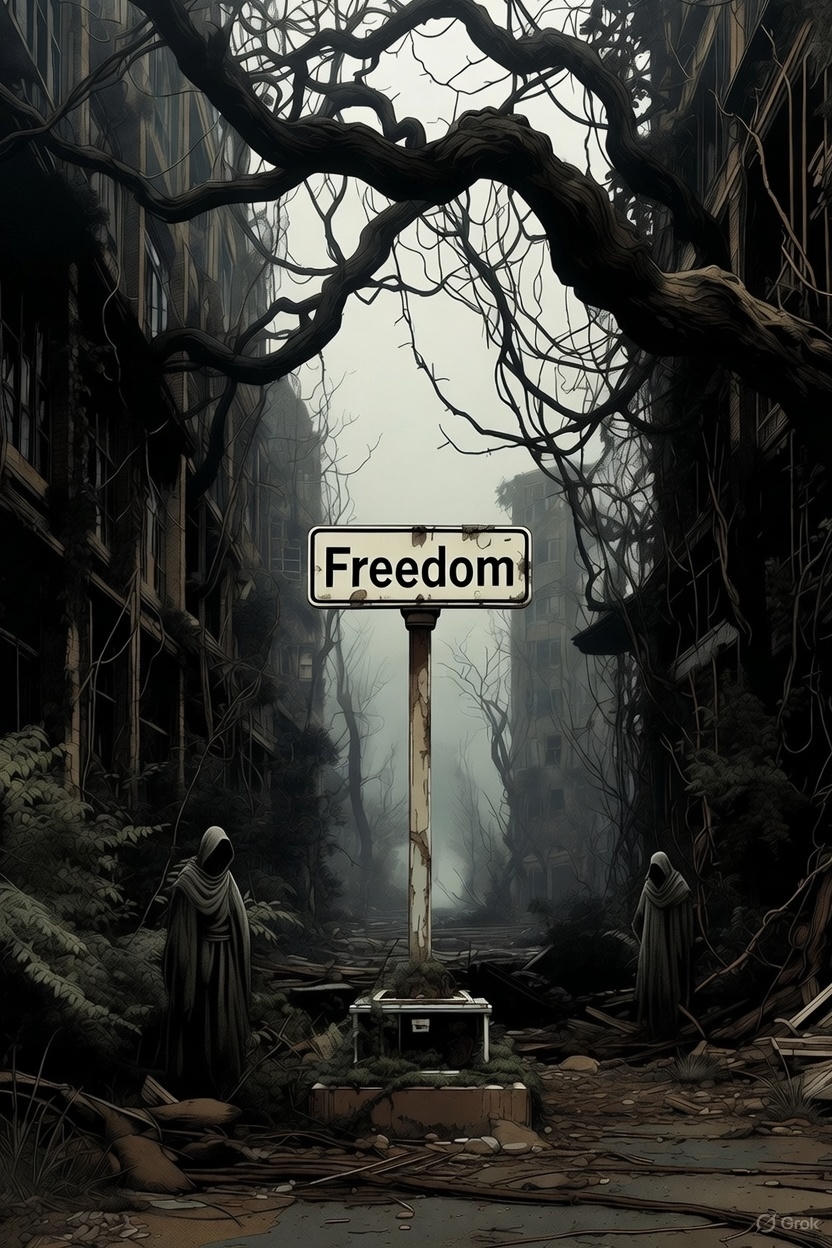
Let us begin our tour of the City. The first signpost we come to is “Freedom”, which means so many things, and different things to different people. But to most people, in most cases, freedom means the exercise of choice, without coercion, instantly or following lengthy reflection, and with immediate results or effect. Examples: I choose to have coffee at a particular moment; I choose friendship with someone I like, rather than with another; I vote any way I please; I seek out information on any topic that intrigues me; I take steps to ignore the constant appeals for contributions that fill my email box; etc. We feel free precisely because we can choose these things and a myriad of others in our daily lives.
But how free are we? If we take “choice” as an index of freedom, it depends on the point of view: from my subjective point of view, I am completely free, since I can choose in any way and on any basis I like. From an external point of view, given that my choices are to a large extent predictable, I am hardly free at all, constrained as I am by my tastes, my training, my development and upbringing, my inheritance, my limitations as a human being confined to a certain discernible context, and my total identity. For the most part, my inclinations of choice are predicted, pre-programmed, and already decided at the moment of choice, frequently making the actual choice moot—not every time, of course. But if we really knew how many of our choices were successfully predicted, most of us would be shocked.
In our interactions with the City, via search engine, application invocation, or any of the other portals we frequent, the resulting menu of choices is curated in great detail in anticipation of our choice—to maximize engagement, satisfaction, and the likelihood of further interaction. Often, the sheer volume of choices on the menu is dazzling, making us think we have all the alternatives that there are—page after page of potential selections.
And then we pick one, thereby enjoying the illusion of freedom: we made a free choice, didn’t we? Yes, but how free was it? If this scenario were conducted in complete isolation, perhaps it was so, but it wasn’t. The contents of your profile, the detailed record of who and where you are and what your past choices and preferences were, decided the content of that menu of alternatives, promoting some, demoting others, hiding certain ones completely. Like it or not, our choice is constrained by a thousand parameters. In choosing, we experienced the illusion of freedom without the substance.
This is the reality, learned from every swipe, every keystroke, every click we enter into the system. Even our dwell times, the measure of engagement, are recorded. While we are searching for a nearby, good restaurant, or a book about our hobby, or the bio of a movie star or politician, the City is building and refining a picture of us, more detailed than we can imagine, connecting that picture with all the other data points it may have access to—profession, net worth, credit card usage, debt, and other records, plus the demographic groups to which we belong—to customize its responses to your personality. While this may result in some very pleasing outcomes (the City likes those; it suggests that you will be back), it is not in the long run done for your benefit but for the benefit of the corporation and its advertisers. Engagement grants the opportunity for advertisement; ads mean money. Simple.
Well, so what? Everyone benefits, right?
Wrong. You have just been subjected to an illusion, a sleight of hand, that grants the feeling of freedom while simultaneously taking it away. This is not just certain interactions with the City—this is happening with all interactions. Every input further refines that electronic twin that defines the basis of your interactions with the City. Twenty-five years ago, your electronic twin was a mere twinkling in the eye of the City’s designated masters, visible as a goal, realized only crudely and dispersed in the technology of the time, a product of both the diversity and homogeneity of the population under examination.
Since then, the technology has greatly improved and expanded, the incentives have been established, and there is a roaring commerce in your metrics, the measurements that make up your electronic twin. Data flows in from portals we are completely unconscious of: where you live, where you work, social media, your cloud storage, even the electronic gadgets in your house, anything that is online, what we call today the Internet of Things (IoT). Unmanageable in the past, “big data” is now routinely processed to discover possible correlations among buying habits, net worth, neighborhood, personal background, social media usage, political, social, or religious expressions, and so on, in order to realize the dream that was on a distant horizon twenty-five years ago: the ubiquitous and all-powerful Curation Algorithm—to tailor the City’s interactions and offerings to the individual, efficiently, effectively, and irresistibly.
And all we had to give in exchange was freedom.
And when the woman saw that the tree was good for food, and that it was pleasant to the eyes, and a tree to be desired to make one wise... —Gen. 3:6 (AV)
The Unholy City is licensed in its entirety under CC BY-NC-ND 4.0.
To view a copy of this license, visit
https://creativecommons.org/licenses/by-nc-nd/4.0/