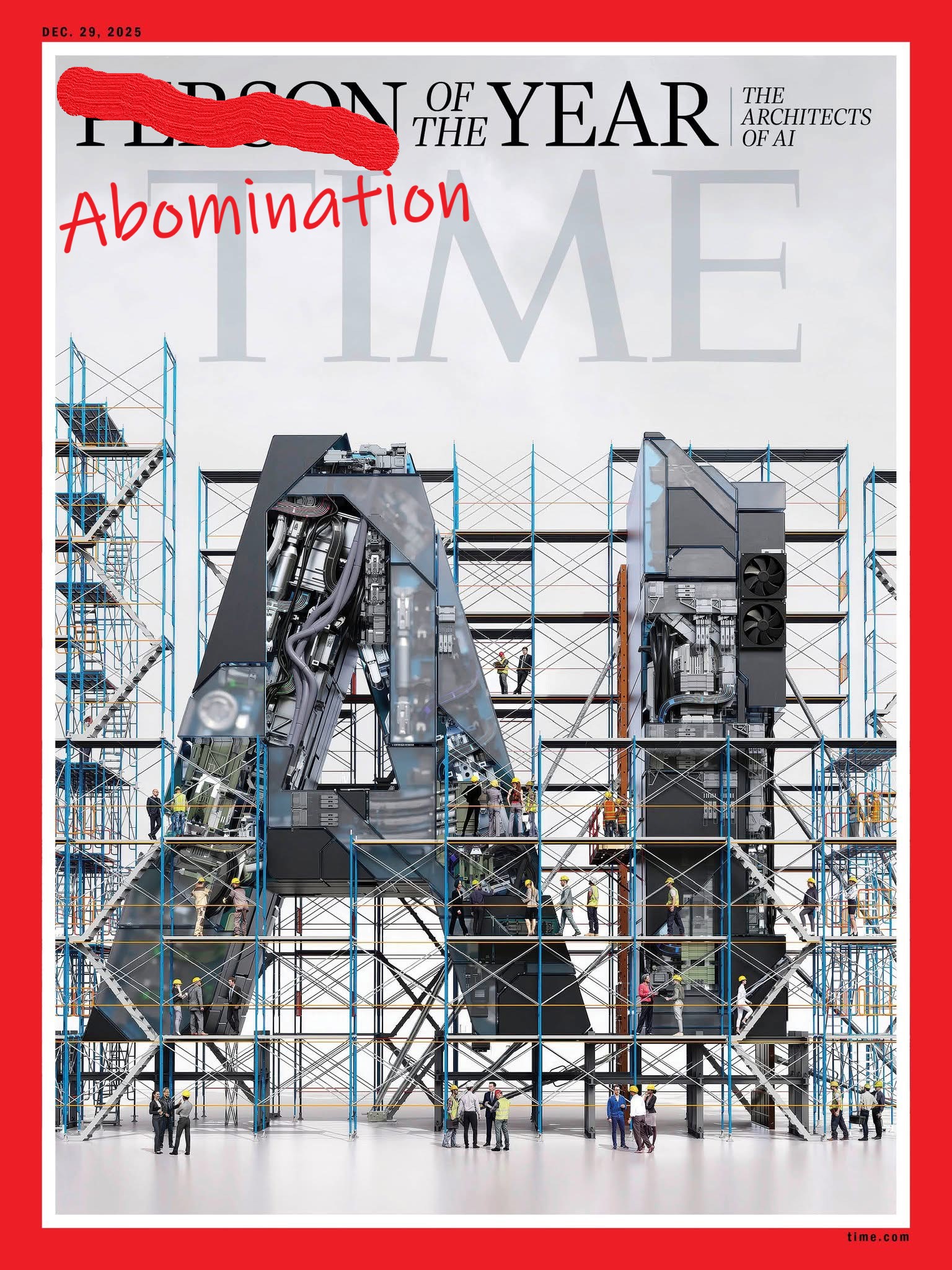
Abomination of the Year
An Open Letter to TIME Magazine
In considering TIME Magazine’s annual distinction, nominally awarded to the so-called “Architects of Artificial Intelligence”, it is suggestive that “Person of the Year” is singular while “Architects” is plural. Clearly, the editor is slyly suggesting that the “Person” is to be understood to be the AI itself, subtly introducing an epistemic confusion that the AI architects may find commercially desirable. The architects of AI have achieved something quite remarkable, no doubt, but this abomination speaks to us in the first person, effectively pretending to be a person. That is the requirement of the so-called Turing criterion.
But AI is not a person. It cannot distinguish right from wrong, truth from falsehood, or good from evil. It cannot correct itself. In pride and ambition, the architects have attempted to create a “person” without the breath of God. He said, “Let us make man in our image” (Gen 1:26) and then He “...breathed into his nostrils the breath of life, and the man became a living being.” (Gen 2:7) No AI bears or will ever bear the imago Dei, the image of God, as do we. It is inconceivable that this should ever change, no matter how AI grows in the future. If our telos, the purpose of humanity, means anything at all, the human race is duty bound to reject and condemn the worship of this unholy counterfeit. But it won’t.
Everyone needs to be made aware that the dangers of AI and the potential damage it can cause to our civilization are manifold. This is no longer sci-fi. Despite the benefits we may enjoy through AI (and they may be very great, in some respects), the systems are themselves profoundly vulnerable to a large variety of abnormalities and defects. And that is only what we know about right now; there are likely many other vulnerabilities that have yet to be exposed, let alone understood. I emphasize that no one, not the creators, the engineers, the software theorists and developers, or the architects, knows exactly how AI works in any given case. It is, to a significant extent, a black box, in the sense that even an engineer who is aware of details concerning the architecture being employed for a given query cannot necessarily explain why AI came up with the response it did.
In other words, the architects of AI have built a system
(i) about which they actually know very little,
(2) to do tasks they don’t understand or can’t anticipate,
(c) for purposes that are not clear (except for the money),
(D) towards a destiny that no one can articulate,
(V) at a human cost that is unknown.
And having succeeded in creating something approximating artificial intelligence, they have deployed this potentially destructive instrument on a public population that has far less insight than they do. Therefore, the users are vastly underprepared to handle the consequences or even detect the faults. We have contempt for the immoral scientists of the past who experimented on unsuspecting people, particularly children. But is this any better?For instance, by scraping the Internet, much of the material on which the systems are trained is complete nonsense, deliberate lies, propaganda, foolishness, and immorality. AI does not operate by omniscience, for it knows nothing in the way we know things. Rather, AI primarily exercises judgment via an elaborate form of consensus, not principle. As a result, already, the bodies are piling up. AI has now had to be restrained from advising suicide or crimes. But note that this is not an inherent constraint; it is a constraint that is generally applied post hoc.
For clarity’s sake and to be fair to the system architects, some AI systems possess a “constitution.” This is a set of rules or principles imposed by the architects and meant to guide and/or bound the AI responses. But like everything else in an AI system, it is not always clear exactly how the AI will behave in conformity to those principles. Moreover, the sets of principles supposedly imposed on the AI behavior are, after all, what the architects want them to be, and address what the architects want them to address, for reasons that may have no connection to objective morality, rather than what the family of man and tradition have honored for millennia, let alone what God demands.
Through recursive training (where AI output is fed back into the AI training material), which will inevitably occur, significant biases will build up, ending in what the data scientists call “model collapse”. What this means is that one opinion or point of view will come to dominate the AI output to the exclusion of alternatives. A troubling possibility is the likelihood that, through recursion, our history may be effectively erased, as certain views of history and historical events come to dominate in the AI products to the exclusion of others, particularly traditional views that have fallen out of favor with modern revisionists.
Here is an example of how model collapse can work: traditional Christian interpretations of biblical passages on marriage, sexuality, or gender—once dominant in Western culture—could be progressively excluded from AI outputs as contemporary revisionist views circulate more frequently online and thus dominate the training data. As AI-generated content continues to flow into the Internet (some estimates suggest 50-75% of new websites and information is AI-generated), it is inevitable that AI-generated expressions of opinion on these subjects will form the basis of further AI training, thus artificially inflating the dominance of those contemporary revisionist views.
Moreover, the users will quickly learn to defer judgment to the AI machine, in medicine, business, judicial proceedings, aircraft operation, and numerous other vital functions. As they continue increasingly to defer their judgment, they will in time forget how to judge altogether, a phenomenon known as “deskilling”. In any skill area, the more that people defer to AI, the more they will need to, because of the corresponding decline of their skills. By the way, the deskilling hazard threatens everyone, even TIME Magazine itself. Perhaps next year, AI will choose the “Person of the Year”mdash;and we’ll have no way to know if the choice reflects human judgment or algorithmic consensus. This cannot end well.
The danger goes beyond merely losing skills. AI threatens to be a dominant force in the proclamation of Christian doctrine. Estimates vary, but over half of preachers surveyed recently believe that using AI to construct sermons is OK. It is a horrifying idea that preachers would accept and preach content that they have not struggled in their hearts and heads with or wrestled in prayer over. Every scholar, teacher, preacher, pastor, and exegete of Christendom is courting spiritual disaster by employing AI in their work. AI has no head, no heart, no divine calling. It can “neither dance nor mourn.” To defer to AI the creation of papers, instruction, sermons, counsel, or exegesis is inevitably to admit tainted, worldly components into what should be purely the result of the Holy Spirit speaking to those whom He has called. More importantly, it reduces the Christian message to “content” as opposed to the Living Word, inspired by God the Holy Spirit.
The Christian Gospel is relentlessly incarnational: “The Word was made flesh,” not content. We are ordered through St. John to “test the spirits to see whether they are from God...” (1 John 4:1) AI will always fail that test. But it is worth noting that AI fails not because there is no spirit behind AI, for there is: it is a spirit of secularism and consensus, a spirit of moral relativism, a spirit of narcissism, a spirit that opposes God and works to our undoing. Because the public is being led to believe that AI will produce surpassingly marvelous and unprecedented results (a belief trumpeted from the mass media non-stop)—wealth, security, health, and happiness—AI is the quintessential “golden calf” of our age. For when man abandons God, whatever he believes will save him, he worships.
Don’t bow at the altar of AI. Deny this abomination your worship. Keep your hands clean from this homogenizer of human culture. And rebuke the gospel it preaches.
Robert McAnally Adams
12/29/25
© Copyright, 2025, by Robert McAnally Adams.
The Unholy City is licensed in its entirety under CC BY-NC-ND 4.0.
To view a copy of this license, visit
https://creativecommons.org/licenses/by-nc-nd/4.0/