Published 4/10/26
The Unholy City
Part II
XI. The Tyranny of the Subjective
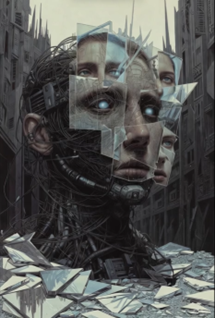
As we stand before this incredibly brave new world (not dystopian fiction but terrifyingly real), we stare at our own image while caught in the features of subjective reality. The City is ready to replicate us in every sense that matters to it. The underpinnings of objective moral reality have been hidden from our perception and stripped away from our cultural consensus. We are left at the mercy (so far as that goes) of our delusions and points-of-view.
The consequences of subjugation to the City for the moral life have already been disastrous, thus fulfilling the projections presented in “When Choice is Unfree”. The City has successfully convinced its citizens to choose the moral code that best nourishes their appetites. The right to choose and assert one’s own moral universe—the cult of “My Truth”—has become the final and successful philosophical defense against the true Law.
In this severing from the moorings of objective morality, something new emerges: the subjective exercises exclusive control. The subjective is elevated to the position of final arbiter, where it exercises an unsensed but absolute and corrosive tyranny that hollows out selfhood.
What is the subjective but a collection of appetites, unaccountable inclinations and impulses, and fragmented self-interest? It is void and without form, unstable, ungovernable, subject to whims and, worse, to the unreal fantasies and imagined narratives that nourish the illusions that fill the void. Telos in these circumstances is not only lost but becomes incomprehensible and meaningless. Truth is no longer merely obscure; it has been erased as an absolute. Truth is now understood to be whatever strengthens one’s subjectively chosen identity.
This is tragic because objective moral reality is not the enemy of self—it is the essential condition. Fixed standards and principles permit the subjective to coalesce around specific, consistent ideals and aims in a way that permits integration with reality and express coherent intentionality. Without objective moral reality, the supposed liberation from external rules is actually dissolution. Objective moral reality provides the structure around which intentionality, identity, and purpose can form. That reality arises from our very ontology—what a human being actually is. The objective moral reality is not a cage but the scaffold required to construct the mature, integrated, functioning self.
The City presents this dissolution as liberation and freedom. The empty materialism of the City systematically hides the objective moral reality by making it culturally inaccessible. Without that reality, the self cannot be a self. The superficially liberating statement, “There are no rules,” contains a contradiction since the statement itself articulates a rule. Basing identity and selfhood on a contradiction is manifestly futile and absurd, like building a house on sand. The result is not free people but atomized appetites wearing the mask of sovereignty.
Unmoored from truth, the atomized self seeks not reality but reflection. The City provides digital echo chambers where such “liberating truth” is employed not to enlighten but to reinforce one’s sin. In that refuge, sin is consistently preached as virtue, acted out in clear conscience, with no dissenting view to be tolerated.
In an ironic way, the feature of AI that results in what was called “model collapse” is analogous to the drift of the untethered soul. In model collapse, the AI’s model of the collapsed subject drifts towards whatever pattern its own feedback amplifies. In a remarkably precise analogy, the untethered self drifts towards whatever it finds attractive, irrespective of moral justification. Justification comes later, after the attraction has been indulged.
Alternatively, Christian content is a niche market in the City, with worship playlists and devotional apps. Churches now compete for engagement metrics. Sermons are optimized for virality. Christian influencers are content creators. Bible study apps are gamified with streaks and achievements. Prayer is reduced to journaling prompts. Worship is an aesthetic experience. There are multiple spirituality options in the marketplace. Christianity is one choice among many, representing “healthy” diversity. Many churches have embraced this, becoming vendors of religious experiences, actively competing on the City’s terms rather than being forced into it.
We see a society today consumed by various gospels: the gospel of wellness, the gospel of personal brand, the gospel of political purity among many others. These are the new forms of obdurate sin, the self-administered quick-fixes that promise salvation and status, all while demanding nothing that would challenge the supremacy of the City’s pragmatic, consequence-based morality. The planners in hell have finally succeeded in erasing the Tablets, bringing forth new tablets, not of stone but of iron.
The City, in its final form, needs no armed guard. It requires no walls. It simply requires our acquiescence, our phone in hand, and the fervent belief that we are, in this moment, entirely free. In our very freedom we writhe in the chains of our chosen captivity to the subjective. In our triumph is our fall.
Only an Act of God can break the captivity of a soul that has so completely chosen its own bondage. That bondage is the conviction that reality is whatever we believe it to be. The consequences of that persuasion are so far-reaching that the whole of The Unholy City, Part III, will be devoted to its discussion.
Grace remains. For all the City’s power, it is still borrowed breath. The machine cannot create, only rearrange. The Image in which we are made cannot be replicated in code. The intelligence of the City ends where love, the good, truth, and beauty begin, for they do not optimize. The antidote to the thinking machine is not ignorance, but reverence—the remembrance that wisdom is born not in circuits, but in communion with God.
The final captivity by the City is not mechanical, economic, or even social, but spiritual: namely, to believe that what can be simulated is sufficient, that imitation equals incarnation. Against that heresy, Christians must proclaim that the Word became flesh, not content.
The Word became flesh and made his dwelling among us. We have seen his glory, the glory of the One and Only, who came from the Father, full of grace and truth.—John 1:14 (NIV)
The Unholy City is licensed in its entirety under CC BY-NC-ND 4.0.
To view a copy of this license, visit
https://creativecommons.org/licenses/by-nc-nd/4.0/